
India’s construction boom in the last decade has completely changed the way our cities look. Enthusiastic social media often film our cities and compare our skylines to the likes of Dubai, which is a remarkable feat.
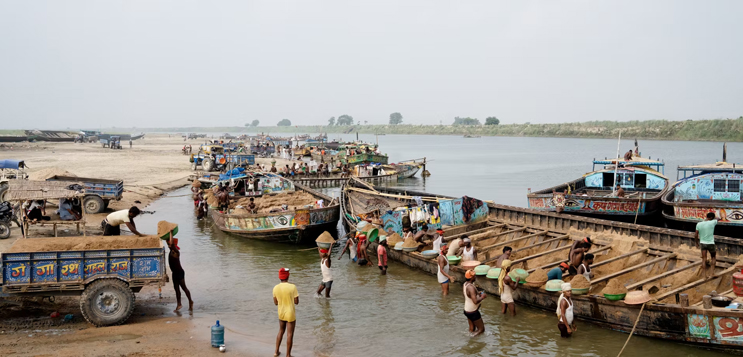
At the same time, just like everything in nature, to get something, you must give something away. And to build our new swanky highways, fancy office spaces, tall apartments and massive malls, we are giving away our sand to the construction industry. By the truckloads. From the banks of Mother Ganga and her many tributaries.
The hands behind illegal sand mining
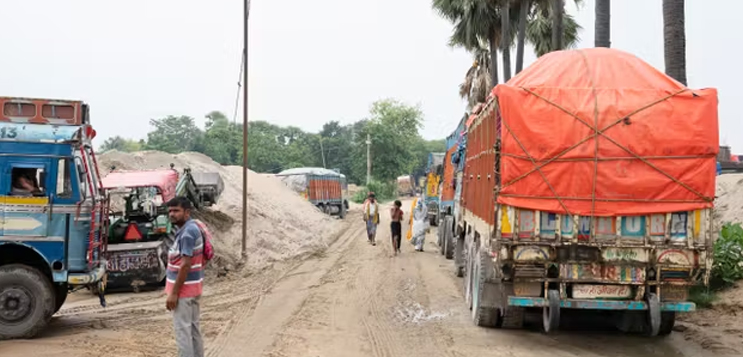
India’s rivers are paying the price as the demand for sand skyrockets across Indian cities. There is a massive black market for sand, thriving in the open, and everyone you can think of is involved in it. Contractors, local government authorities, corrupt police officers, goons with links to politicians, the entire system is neck deep in it.
A report by Prem Mahadevan says that much of the illegal sand extraction is now mechanical and at a massive scale. While the sheer scale of the sand mining mafia maybe difficult to quantify, the business itself is so profitable that ‘security guards’ at sites often carry firearms, ready to be brandished should anyone, such as journalists, NGO workers, environmentalists or others, show any interest in the activities. In the past, the mafias have also been reported to burn journalists to death.
The report also adds that there’s no single entity or structure for these activities. In fact, each province, or even each locality within a province, may have multiple and competing sand mafias competing for a share of the decadent pie. Local villagers are usually employed with the mining activities, and often enjoy support from the local administration, since it helps them earn a ‘decent income’.
Le Monde, one of France’s leading newspapers, reports that Bihar, Madhya Pradesh and Uttar Pradesh are the three states that are infested with sand mining mafia gangs.
Why is extracting sand from rivers harmful?
The river sand beds help to regulate flow, supports groundwater recharge, stabilises riverbeds and banks, and sustains aquatic habitats. When extraction goes too far, that balance begins to fail. India’s own sand mining guidelines place replenishment studies at the centre of sustainable extraction for precisely this reason.
That regulatory concern is now becoming harder to ignore. In August 2025, the Supreme Court reiterated that a proper replenishment study is a mandatory precondition for sand mining approvals, reinforcing the idea that mining cannot be treated as routine without scientific assessment of what a river can actually bear.
So, if India is to sustain its construction boom, build highways, new offices, shopping spaces and housing for its vast population, where will the sand come from?
Can M-sand be a sustainable alternative and save our rivers?
Good-quality M-sand is an engineered construction material that can reduce sand mining and save our rivers. It is produced by crushing hard rock, then screening, grading and often washing the material so that it meets construction requirements more consistently. Under IS 383:2016, manufactured sand is recognised as a type of fine aggregate used in concrete, and the standard classifies fine aggregates into grading zones based on application.
One of the best arguments in favour of M-sand is that it can replace river sand and can be produced with greater consistency. River sand quality varies depending on source, season and handling. Properly manufactured M-sand, by contrast, can be processed to a desired grading and impurity level. This is also one reason some state policies have begun treating it as a formal part of the construction ecosystem rather than as a fallback substitute. Rajasthan’s M-Sand Policy 2024 is explicitly designed to reduce dependence on river sand and scale production through procurement mandates and incentives.
Why hasn’t India accepted M-sand?
Small contractors and homeowners often continue to prefer river sand because it feels familiar and more workable, especially in plastering. Masons are used to its texture, and ‘natural’ still carries weight in material decisions even when that material is inconsistent or impure. Quality inconsistency makes that hesitation worse. Not all M-sand sold in the market is produced to the same standard. Poorly processed material with excess fines can increase water demand in concrete and damage confidence in the category. That is why certification and testing matter so much.
In addition, M-sand is not impact-free. It depends on quarrying, crushing, transport and, in many cases, water-intensive washing. So, the sustainability comparison is not between a harmful material and a perfect material. It is between two different kinds of extraction, one of which is easier to regulate, standardise and integrate into a more formal supply chain.
However, M-sand production, for all its own environmental footprint, can at least be monitored through licensing, plant-level standards, procurement rules and industrial controls. That makes it a more governable material, which in a sector like construction can matter almost as much as the material itself.
Policy needs to change
For M-sand to reduce India’s dependence on river sand in a meaningful way, three things need to happen together.
First, quality assurance must improve. Builders need clearer certification and more confidence that what they are buying meets the required standard. Second, state policy must do more than announce support. Procurement mandates, logistics support, local plant availability and compliance checks are what convert policy intent into market change. Third, illegal mining survives because it is profitable and cheaper in the short term. That means M-sand is competing against a natural resource that is deeply entrenched with the black market. Enforcement of laws is the need of the hour.
What could be the realistic solution against sand mafia?
India is unlikely to stop using natural sand overnight. On the other hand, M-sand is not a flawless answer to the country’s construction footprint. But that is not really the test.
The real test is whether India can reduce its dependence on ecologically damaging river extraction while still meeting construction demand. On that question, manufactured sand looks less like a niche alternative and more like one of the few scalable options available today. It will not solve the sand problem by itself.
But if quality improves, supply becomes more dependable and policy support turns into real market structure, M-sand can move sand supply away from rivers and into a system that is at least easier to regulate.
