
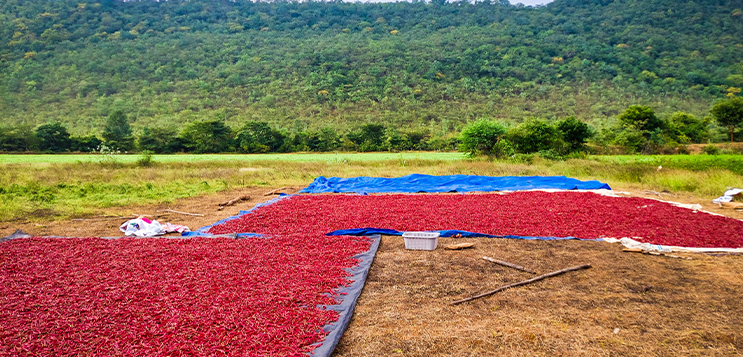
Chilli is one of those spices that reigns supreme in Indian kitchens. It is everywhere, quite literally. The chilli is sold as fresh in vegetable markets, dried under the sun, ground into powders and mixed into pickles, sauces, snacks and packaged foods. It also travels far beyond the domestic market as one of India’s most recognisable spices. However, despite its popularity, chilli remains an incredibly difficult spice to grow.
The plants face repeated attacks from thrips, mites, whiteflies, fruit borers and diseases carried by insects. In recent years, the invasive Thrips Parvispinus has caused severe damage in chilli-growing areas of Andhra Pradesh, Telangana and Karnataka, illustrating how quickly a pest outbreak can threaten an entire crop.
For farmers who have already spent on seedlings, labour, fertilisers and irrigation, waiting to see whether an infestation worsens can feel like an unacceptable risk. Pesticides therefore become a form of crop insurance, and that is where the chilli problem starts.
Why the Indian chilli is chemically dependent
Chilli is a high value crop that has little tolerance for failure, which forces farmers to spray chemicals repeatedly. Pest damage can reduce yield and affect the colour, appearance and quality that determine market prices. Viral diseases spread by sucking pests add another layer of uncertainty because affected plants may not recover. Thus, amidst all this, the local pesticide dealer becomes the person who has the best source of crop advice.
The sustainable alternative here is to provide the right tools to farmers when pest populations threaten the crop. The goal should be a residue-safe production system in which chemicals are selected carefully, applied only when needed and supported by biological, cultural and preventive practices.
When a farm decision becomes a trade problem
Importing markets regulate pesticide residues through Maximum Residue Levels, or MRLs. The European Union defines an MRL as the highest level of pesticide residue legally tolerated in food or feed when a pesticide has been applied correctly. Where a pesticide is not specifically listed, a default EU limit of 0.01 milligrams per kilogram generally applies.
The difficulty is that chilli rarely travels from one identifiable farm directly to an exporter. Produce from several farms may be collected by traders, dried, stored, graded and mixed before processing. By the time a laboratory detects a non-compliant chemical, tracing it back to the original plot, spray or application date may be difficult.
India already has a substantial testing and quality-control system through the Spices Board, which evaluates export consignments against applicable safety and quality requirements. The Board’s schemes also recognise the importance of improving post-harvest systems and building stakeholder capacity. Yet laboratory testing remains defensive. It finds the problem after farmers, traders, processors and everyone else associated in the industry have already spent their money.
A more sustainable system would prevent avoidable residues through registered farms, approved input lists, spray records, pest surveillance, observed pre-harvest intervals and risk-based testing before the crop enters a larger mixed lot.
Read More: Indian Spices Are Being Rejected Across Europe – Find Out Why
What integrated pest management would change
Integrated pest management, or IPM, offers a way to reduce dependence on routine spraying without leaving farmers defenceless.
In practice, this could begin with healthy seedlings, tolerant varieties, crop rotation and cleaner fields. Farmers can monitor pests using sticky or pheromone traps, remove virus-infected plants and use neem-based or microbial products where these are effective. Natural predators can be protected instead of being eliminated through broad-spectrum spraying.
Chemical pesticides remain available, but their use becomes more targeted. Farmers apply them after monitoring pest populations, rotate modes of action to slow resistance and respect the waiting period between spraying and harvesting. ICAR research has examined combinations of pest-management practices for chilli, while other Indian studies have shown that measures such as crop-residue mulch can help suppress sucking pests, including thrips and whiteflies.
Cleaner chilli needs a business model
Residue-safe chilli will remain confined to projects and model farms unless it also makes economic sense. Traps, biological products, farm records, agronomic advice and laboratory tests all cost money. Farmers may also fear that reducing familiar sprays will expose them to greater crop losses. Meanwhile, exporters and processors receive much of the commercial benefit when produce meets demanding market standards.
That imbalance needs to change. Exporters and processors could source through longer contracts, provide approved input packages and fund field agronomists. Farmer Producer Organisations could manage shared pest monitoring, record-keeping and pre-harvest testing. Assured procurement or a clear premium for verified produce would give farmers a reason to take on the additional discipline and perceived risk.
Traceability that supports farmers
India has built digital traceability into agricultural exports. APEDA’s HortiNet system connects certification and traceability information for several fresh horticultural products. In March 2026, APEDA also introduced the Veg.Net portal to strengthen monitoring and traceability for green chilli and drumstick exports to the European Union, followed by sampling and analysis guidance.
This is an important development, but traceability should not become another administrative burden transferred to individual smallholders. FPOs, cooperatives and exporters can maintain digital spray records, laboratory results and lot identities on farmers’ behalf. Compliant produce must then remain separate during procurement, drying and processing. Otherwise, careful production on one farm can lose its value when mixed with an untraceable consignment.
At the end of the day, India’s problems with the sensitive chilli crop can only be solved when safer cultivation is made possible financially at the very beginning and then protect it at every further step ahead.
