
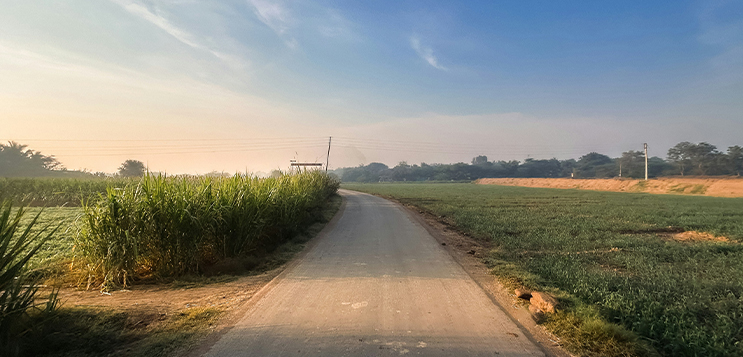
Sugarcane sits deep inside India’s rural economy. It supports farmers, feeds hundreds of mills and produces sugar, molasses, alcohol, electricity and transport fuel. In 2024–25, India harvested about 454.6 million tonnes of sugarcane from nearly 5.45 million hectares. The crop’s Fair and Remunerative Price was also raised to ₹355 per quintal for the 2025–26 season, underlining its continued political and economic importance.
But running this vast sugarcane empire requires water and that is a limited resource.
A NITI Aayog task force estimated that producing one kilogram of sugar may require around 1,500–2,000 kilograms of water. It also warned that the pressure created by sugarcane cultivation was becoming particularly serious in states such as Maharashtra. A practical solution to this is to create a water-budgeted sugar economy: one in which cane is encouraged only where local water systems can support it, mills share responsibility for reducing water use, and farmers in severely stressed regions receive credible markets and income support to diversify.
Why farmers continue to grow sugarcane
Farmer economics is at the very heart of this discussion. Sugarcane offers something many lower-water crops do not: an established buyer. Mills provide a relatively organised procurement system, government-declared prices create a degree of predictability, and most importantly, the crop can offer dependable returns where irrigation and mill access are available. As a result, farmers will not replace sugarcane with pulses or oilseeds.
NITI Aayog’s sugar-sector task force acknowledged this problem. While recommending that some sugarcane area in water-stressed regions shift to less water-intensive crops, it also proposed financial support to compensate farmers for possible income losses.
Water efficiency must begin on the farm
The first part of a water-budgeted sugar economy is improving how cane is irrigated. Flood irrigation remains common in sugarcane cultivation. Water is released across the field, often with limited control over how much reaches the roots. Losses through runoff, evaporation and deep percolation can be substantial.
Drip irrigation offers a more efficient model by delivering water closer to the plant. A NITI Aayog study reviewing evidence on micro-irrigation found that one sugarcane study recorded a 23% increase in productivity and a 37% reduction in water use compared with flood irrigation. Drip can also work alongside fertigation, soil-moisture monitoring, irrigation scheduling, trash mulching and better ratoon management.
However, drip irrigation is often presented as a simpler solution than it is. Farmers face high installation costs, subsidy delays, clogged emitters and maintenance problems.
Sugar mills must become water partners
Sugar mills shape where cane is grown, how much is procured, which varieties are distributed and what support farmers receive. Yet water responsibility is usually placed almost entirely on growers. That is difficult to justify when mills depend on a stable cane supply and often influence the crop choices of entire regions, such as the crisis that is currently unfolding in Maharashtra.
A stronger system would require mills to operate within regional water budgets. Before expanding capacity or increasing procurement, they could be expected to assess groundwater stress and publish plans covering drip-irrigation adoption, water-use reduction, treated-water reuse and crop diversification. Mills could also help finance irrigation systems, provide agronomic support and reward verified water-saving practices.
Not every region should follow the same sugarcane model
Sugarcane’s sustainability depends heavily on where it is grown. Rainfall, groundwater availability, irrigation access and local livelihood options vary widely across the country and that is how policy needs to be designed as well.
A water-secure district may be able to continue producing cane while improving efficiency. A moderately stressed region may need strict drip-irrigation targets and tighter limits on expansion. A severely stressed area may need gradual diversification supported by procurement guarantees and income protection.
The Central Ground Water Board already classifies assessment units according to groundwater extraction and recharge. Such data should influence decisions on mill expansion, public subsidies and future cane acreage. This is where the idea of a water budget becomes practical.
Ethanol adds another layer to the debate
India’s ethanol programme has strengthened the economic case for sugarcane. The country achieved petrol blending of 19.24% during the 2024–25 ethanol supply year and continues to pursue a 20% blend. Sugar- and molasses-based distilleries remain an important part of that strategy.
Ethanol can reduce oil imports and create another market for agricultural output. But cane-based ethanol also carries the water footprint of the crop from which it is made. This does not make ethanol inherently unsustainable. It means feedstocks should be judged by their full resource footprint, including water.
A more resilient ethanol strategy would diversify production across molasses, damaged grain, agricultural residues and second-generation technologies. Feedstock choices could also vary according to local water conditions rather than being driven only by available processing capacity. Every litre of domestically produced ethanol should not automatically be treated as equally sustainable.
Water management must continue inside the mill
Farm-level efficiency can be undermined if processing remains water-intensive. Sugar mills and distilleries use water during crushing, cooling, cleaning and fermentation. They also generate wastewater that must be treated before reuse or discharge.
A sustainable sugar economy would therefore require lower freshwater intake, greater recycling of process water and responsible reuse of treated effluent. Mill-level water performance should be measured alongside farm-level irrigation efficiency. This creates a complete chain of accountability: from the field where cane is grown to the factory where it is processed.
Towards a water-budgeted sugar economy
A water-budgeted sugar economy would combine regional crop planning, efficient irrigation, accountable mills, diversified ethanol feedstocks and stronger markets for alternative crops. It would reward water productivity rather than volume alone and prevent further expansion in regions where groundwater systems can no longer carry the burden.
Sugarcane will remain important to India. It supports farmers, factories, fuel policy and entire rural economies. But water is a limited resource and, in the years, ahead, it will get increasingly important to ensure how many additional tonnes of sugarcanes should be grown.
