
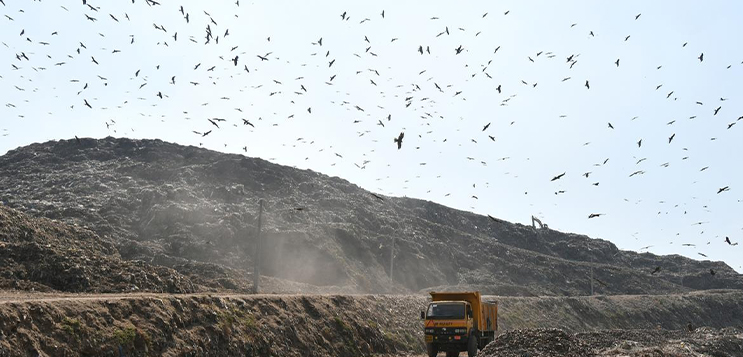
The Ghazipur landfill in Delhi now rises nearly as high as a seventeen-storey building. Trucks continue to unload waste at its base every day, even though the site officially crossed its capacity years ago. The Municipal Corporation of Delhi, has set an ambitious target of closing the landfill by 2027, but it is highly likely that the target shall be missed.
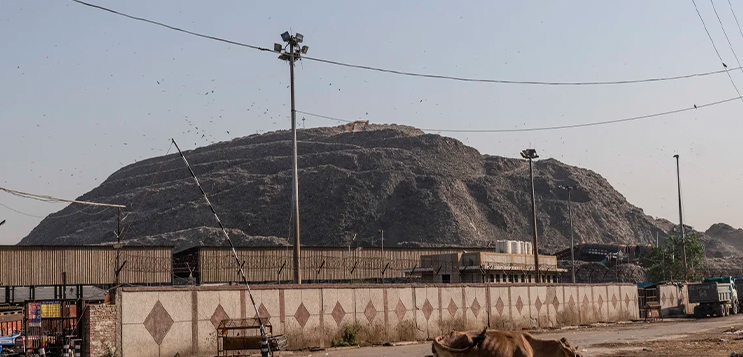
A short drive from the Ghazipur landfill reveals another of Delhi’s famous monuments, the Bhalswa landfill. Similar waste mountains are growing in cities across India, from Dhapa in Kolkata to Deonar in Mumbai.
Surprisingly, India is often cited as one of the world’s leading plastic recyclers, recovering an estimated 60 percent of its plastic waste, a rate higher than many developed economies. Yet the country’s landfills continue to grow.
If India is recycling so much plastic, why are mountains of waste still expanding?
The answer lies in a structural gap between recycling performance and the larger sustainability system surrounding plastic production, consumption and waste management. On top of that, the 60% recycling rate applies only to recoverable plastic, not the total plastic entering the waste stream.
Recycling cannot keep pace with rising plastic consumption
India’s plastic use has grown rapidly over the past decade. Rising incomes, urbanisation, food delivery services and e-commerce have all increased the demand for plastic packaging. According to government estimates in 2022, India generates over 3.5 million tonnes of plastic waste each year, although independent assessments suggest the real figure may be significantly higher.
Even if recycling systems remain efficient, they are often unable to keep pace with this rising consumption. Recycling works on the waste that is collected, but when overall plastic use grows faster than recovery systems can expand, large volumes inevitably end up in landfills. Thus, the most effective solutions lie in limiting unnecessary plastic production in the first place.
Infrastructure gaps weaken the recycling system
India’s recycling success is frequently attributed to an extensive informal collection network. However, this system operates alongside significant infrastructure gaps.
Many Indian cities still struggle with segregation of waste at source, meaning recyclable materials are often mixed with organic waste. Once contaminated, plastic becomes far more difficult and expensive to recycle.
Municipal waste collection systems also vary widely in efficiency. While some cities have begun investing in material recovery facilities and improved sorting technologies, many urban areas continue to rely on basic waste transport and dumping operations. Furthermore, in cities such as Gurgaon, much of the waste management systems is controlled by local mafias.
Without stronger infrastructure for segregation, collection and processing, a substantial share of recyclable plastic inevitably finds its way to landfill sites.
The environmental cost of landfill dependence
The consequences of landfill expansion go far beyond visual pollution. Large waste dumps generate methane emissions, which drives climate change, leachate, a toxic liquid formed when rainwater passes through waste, contaminating water bodies.
Plastic waste adds another layer of environmental risk. Over time, plastics break down into microplastics, which can enter waterways, agricultural soils and eventually the food chain.
The invisible workforce behind India’s landfills
Across Indian cities, thousands of waste pickers recover recyclable plastics directly from streets, landfills, and household waste. These materials pass through layers of scrap dealers and aggregators before reaching recycling units. This network plays a crucial role in extracting value from waste that municipal systems often fail to process.
Estimates suggest that India’s informal waste sector may recover over half of all recyclable plastics in the country. Their work significantly reduces the burden on landfills while supplying low-cost raw materials to recycling industries.
However, this system operates with very limited social protection, formal recognition, or infrastructure support. Waste pickers frequently work in hazardous conditions, without stable incomes or access to safety equipment. At the same time, their exclusion from formal waste management planning creates inefficiencies in the recycling system.
Moving from waste management to a circular plastic economy
India’s landfill crisis reveals a deeper structural issue: the country’s plastic strategy has largely focused on managing waste after it is created, rather than redesigning the system that produces it. Recycling helps recover value from discarded materials, but it operates at the tail end of the plastic lifecycle.
Designing packaging for recycling
One of the most immediate opportunities lies in designing packaging for recyclability. A significant portion of plastic waste today consists of multilayered packaging used in snack packets, sachets, and food wrappers. These materials are lightweight and cost-effective but notoriously difficult to recycle because they combine different types of plastics and aluminium layers. Shifting toward single-material packaging formats or designs that are compatible with existing recycling technologies could dramatically improve recovery rates.
Read more: Here’s how India is changing its packaging with the help of seaweed
Building segregation infrastructure
Infrastructure will also play a decisive role. Efficient circular systems depend on segregation at source, reliable waste collection networks, and advanced sorting facilities capable of processing different grades of plastic. While India’s informal recycling sector performs an extraordinary service by recovering materials from the waste stream, scaling a circular economy will require stronger municipal infrastructure, modern material recovery facilities, and investments in technologies that can process complex plastic waste.
Fixing the EPR framework
Policy instruments such as Extended Producer Responsibility (EPR) can help accelerate this transition by aligning economic incentives with sustainability goals. Unfortunately, the EPR policy itself is ridden with multiple loopholes across various stages, which end up harming the environment all over again.
Reports of fraudulent recycling certificates, weak oversight of Producer Responsibility Organisations (PROs), and the limited integration of the informal waste sector have raised questions about the credibility of the current system. You can read more about it here: The Plastic Recycling Scam Hiding Behind India’s EPR Policy.
Much is left to be done to fix India’s landfills
Credit where it’s due, India’s recycling sector has achieved remarkable results under difficult conditions. Unfortunately, that itself has not been able to challenge the growth of our cities’ landfills from achieving skyscraper like heights.
At the end of the day, solving India’s landfill crisis will depend less on how efficiently the country handles waste and more on how intelligently it designs the plastic economy itself. Unless reduction, reuse and responsible production become central to India’s plastic economy, the country may continue recycling plastic while its landfill mountains keep growing.
