

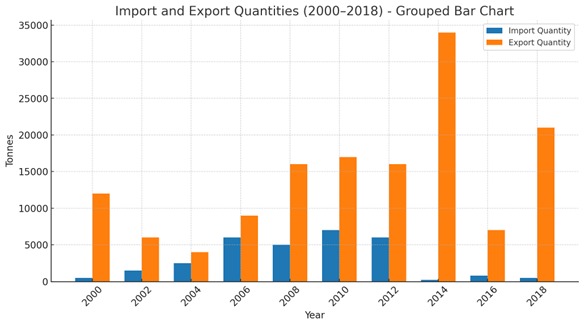
Walk into any fast food joint in Manila, Dubai, or Bangkok, and you are likely eating French fries from India. Over the last five years, India has quietly become a major exporter of frozen fries, over 135,000 tonnes in 2023–24. In fact, we now export more fries than we consume at home. That’s quite a leap for a country that was once an importer of frozen potato products.
The secret? A mix of strong potato production, especially in Uttar Pradesh and Gujarat, paired with big processors like McCain, HyFun, and Iscon Balaji, who work with farmers through contract farming. Farmers receive high-quality seeds, training, and guaranteed buyers who are willing to pay handsomely for their produce. Companies get the exact type of potatoes needed for crispy fries. It’s been a win-win, and the story so far has been one of growth and global reach.
However, as the European Union begins to enforce the Green Deal and Farm to Fork strategy, things are starting to become complicated.
What does the European Green Deal mean for Indian potato farmers?
The EU has set itself a bold target: making Europe climate-neutral by 2050. As part of this, its Farm to Fork (F2F) policy is tightening the rules around how food is grown, whether in Europe or India. For food items such as potatoes, Europe is imposing very strict limits on pesticide residues in crops (much lower than in India). Furthermore, they are tightening the leash around acrylamide control with benchmarks, a substance that forms when potatoes are fried.
Therefore, if any Indian exporter, and by extension, an Indian farmer wants to sell potatoes to Europe, the produce and processing methods must meet these new standards.
Green Deal regulations: Easy, but for some
Large processors are well-positioned to meet these challenges. With full control over their supply chains, rigorous residue testing, and ongoing investments in regenerative farming, they can adapt to EU rules. For them, compliance is challenging but entirely feasible.
Small farmers, however, face a significant challenge. Many rely on pesticides, such as mancozeb and chlorpropham, that have already been banned in the European Union. Switching to approved alternatives, keeping detailed farm records, and paying for repeated lab tests is expensive and complicated. A European retailer may demand not just EU standards but even stricter private ones. For a smallholder, this could mean being shut out of a market they can’t afford to comply with.
What if Europe starts buying French fries from other countries?
Currently, most of India’s fries are exported to Asia and the Middle East. Europe is not a big buyer yet. But Europe is the world’s largest consumer of frozen potato products. If India wants to grow its export footprint, breaking into the EU is key.
The bigger danger, however, lies elsewhere. Many Asian and Middle Eastern countries closely monitor European regulations and often follow suit to maintain open trade ties with the EU. If these regions also adopt EU-style pesticide and acrylamide regulations, Indian exporters could lose their current lifeline. What is today a thriving export market could suddenly shrink, leaving both small and large producers scrambling for alternatives.
It is naïve to think this is just a theoretical risk, since the same thing happened with Indian spices. For decades, Europe had a fondness for Indian spices, but as other countries adopted stricter and more sustainable farming and processing practices, European buyers shifted their preferences. India lost significant ground because it was unable to keep up with evolving standards. The French fries industry now risks heading down the same road if preparation doesn’t start now.
What is the way forward for Indian potato farmers?
Preparing Indian potatoes for the European market, as well as for any future market that may adopt similar regulations, is feasible. However, what the farmers need is strong support from the government and private institutions. Small farmers cannot make this transition on their own. Compliance with strict standards requires a collective organisation, financial backing, technical expertise, and political momentum. Farmer-Producer Organisations (FPOs) can play a big role in this by pooling resources for testing, certifications, and storage.
However, they require subsidies and easier access to export schemes to remain viable. Large processors may extend some support through training and contract farming, yet this will not cover the vast majority of independent growers.
A coordinated, nationwide effort is essential. Government policy, industry partnerships, and farmer organisations must move together. Subsidised testing labs, streamlined certification, and accessible extension services will provide small farmers with a genuine opportunity to compete. Without this support, the gains of India’s booming French fries export sector will remain concentrated among a few corporations. Worse, if more importing countries align with EU rules, India’s French fries story may go soggy just as soon as things were starting to get crispy.
