
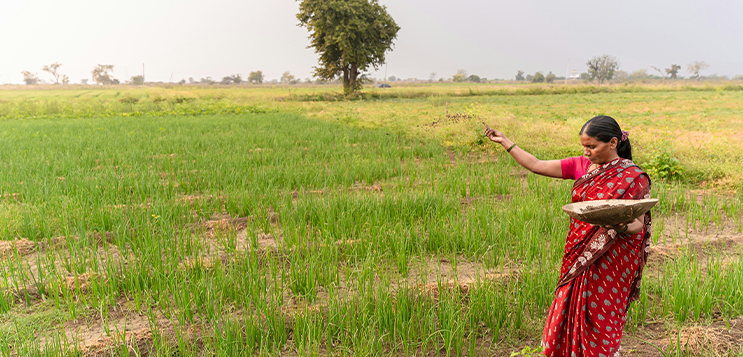
For decades, Indian agriculture relied on an extensive range of chemical pesticides and fertilisers to maximise yields. Many of these products, though effective, carry active ingredients that are restricted or entirely banned in the European Union. The rest of the pesticides and fertilisers that were allowed are also under scrutiny now, and countries have been notified of the minimum residue levels (MRLs) which they must stick to if they are to keep selling their products to Europe.
As a result of all this, the once-booming agri-trade relationship between India and the EU is now more fragile than ever. However, the same push towards sustainability might bring a very welcome change to Indian agriculture.
Indian biopesticides are now necessary
With the EU pushing for sustainability and MRLs being at their lowest ever, it is time for Indian farmers to start using biopesticides and biofertilizers. What was once restricted to organic farming or high-value horticulture now needs to be implemented across the entire agriculture industry.
To understand the rapid rise of biological inputs, it helps to look at what they really are. Biofertilizers and biopesticides are made from naturally occurring microorganisms, fungi, plant extracts or beneficial bacteria. They improve soil fertility, suppress pests, and support plant growth without leaving harmful residues. Instead of overwhelming the ecosystem with chemicals, they work with the soil’s existing biology.
For Indian farmers, who have long depended on synthetic fertilisers and pesticides, these biological inputs were once seen as unreliable or slow-acting. That perception is now changing. Products like Rhizobium for pulses, Azotobacter and Azospirillum for cereals, phosphate-solubilising bacteria for nutrient uptake, and mycorrhizal fungi for root development are finding genuine traction in the fields.
In pest management, neem-based extracts, Trichoderma, Bacillus thuringiensis and Beauveria bassiana are becoming common names, especially among farmers hoping to comply with global residue norms.
Most importantly, these options are locally produced and widely distributed. Companies like IFFCO, Kribhco, Biostadt, AgriLife, Anand Agro Care and IPL Biologicals dominate the biofertiliser market, while Godrej Agrovet and T. Stanes are leading on neem-based biopesticides.
Many state agriculture departments run their own biofertiliser units, and Krishi Vigyan Kendras across the country stock biological products seasonally. Online platforms such as DeHaat, BigHaat and Agribegri have made access easier even in remote districts.
The Government is also pushing for Indian biopesticides
Government programmes are reinforcing this transition. The National Mission on Sustainable Agriculture and Paramparagat Krishi Vikas Yojana actively promote biofertilisers. Increased funding for microbial input units through NABARD has allowed states like Maharashtra, Tamil Nadu, and Andhra Pradesh to scale production. Even export bodies like APEDA encourage farmers to use biopesticides for residue-sensitive crops.
But the real push is coming from the ground.
Many Indian farmers no longer trust heavy chemicals. Yield spikes that once came easily now flatten after years of overuse. Soil nutrients fall, the pest cycles worsen, there is a marked decrease in the water tables, and then there’s the human cost, which Indian villages can’t escape.
Lessons to learn from Malwa, Punjab
If anyone needs a reason why India must accelerate its shift to Indian biopesticides, they only need to look toward Punjab’s Malwa region, which was once known as the “cotton bowl of India.”
For decades, Malwa’s cotton farmers used cocktails of chemical pesticides, including endosulfan, phosphates, and organochlorines, many of which are now banned in India and globally. These harmful chemicals were sprayed weekly, sometimes daily. With the passage of time, the soil degraded, the water bodies started turning toxic, and there was a huge rise in cancer cases in the region.
So many patients travelled from Malwa to Bikaner for treatment that the train they boarded earned a chilling name: “The Cancer Train.”
A 2013 study by the Post Graduate Institute of Medical Education and Research (PGIMER), Chandigarh, confirmed unusually high rates of cancer in this belt. Multiple independent studies later linked this spike to high pesticide contamination in soil and groundwater.
The shift to Indian biopesticides cannot be delayed
Indian agriculture cannot afford another Malwa. Thankfully, Indian biopesticides offer a route out of this trap. They cost less than many chemical options, reduce the risk of export rejection, and revive soil health. They protect farmers rather than expose them to chronic chemical toxicity. Finally, they help align India with the world’s sustainability standards.
What’s stopping Indian farmers from using them freely is not a lack of willingness but a lack of access, awareness and quality assurance. Many rural markets still stock expired biologicals. Cold-chain storage is weak. Laboratory testing capacity remains limited. But the cost of inaction will be far higher.
There is a sense of urgency in Indian agriculture
Indian farmers are standing on a road that goes in two separate ways. One path continues the old way: heavy chemicals, degrading soil, rising health risks, and export uncertainty. The other path is slower at first, but more stable: built on microbes, biodiversity, soil regeneration, and cleaner, residue-free crops.
Europe’s regulations have made this choice unavoidable. Malwa’s tragedy has made it morally urgent. If Indian agriculture is to keep its export markets, protect its farmers, and regenerate its land, then the biological turn must not be slow. It must be decisive. It must be now.
