
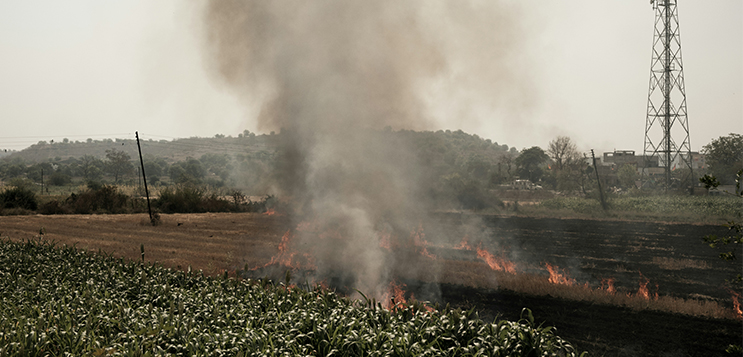
In North India, the paddy straw is a symbol of crisis that makes national headlines come the winter season. But before it becomes smoke, it is still biomass. It contains cellulose and hemicellulose, the same basic building blocks that allow plant-based residues to be converted into paper pulp, fibre boards, moulded products, compostable tableware, bioenergy and bio-based packaging.
What that basically means is that paddy has all the markers that can make it into a very sustainable raw material that can be used in the packaging industry. Let’s look into it with a bit more depth here.
How much paddy is there in North India?
Punjab’s own paddy straw management plan submitted to the Commission for Air Quality Management notes that the state generates around 19.3 million tonnes of paddy straw from roughly 30.79 lakh hectares under paddy cultivation in 2025. It also explains the core difficulty: the time between paddy harvesting and wheat sowing is short.
Thus, this basically shows that India is suffering from a major stranded biomass problem, which can be effectively transformed.
What are the sustainable use cases for paddy?
Paddy straw can be processed into pulp for paper, cartons, trays, cushioning material and fibre-based packaging. More importantly, using paddy for packaging is an interesting angle because it links two environmental problems that are usually discussed separately: crop residue burning in India and plastic waste. India is already trying to reduce avoidable single-use plastic while strengthening recycling and Extended Producer Responsibility.
According to the Ministry of Environment, Forest and Climate Change, about 207 lakh tonnes of plastic packaging waste have been recycled since the EPR guidelines came into force in 2022. Yes, enforcement is the cure, but paddy straw packaging can be a part of prevention.
Read more: The Plastic Recycling Scam Hiding Behind India’s EPR Policy
The farmer does not feel the need to change
The key economic problem is on the ground, where farmers prefer burning the paddy because handling costs are high compared to the value they receive. On top of that, the even harder part is collecting millions of tonnes of straw from scattered farms, drying it, baling it, storing it safely, transporting it affordably and supplying it consistently to factories. As of now, the farmer does not have a reason to participate in the process.
What is the stance of the Government on paddy?
In 2025, CAQM reported that Punjab recorded 5,114 farm fire incidents, down 53 percent from 2024, while Haryana recorded 662 incidents, also down 53 percent. The Commission credited state and district action plans, crop residue management machinery, enforcement, ex-situ utilisation, biomass energy, industrial boilers, ethanol, paddy straw pellets and commercial uses including packaging.
The government has also pushed biomass pellet use in thermal power plants and brick kilns. CAQM has directed thermal power plants within 300 km of Delhi to co-fire biomass pellets or briquettes, while crop-residue utilisation rules mandate a minimum five percent blend of pellets or briquettes with coal in thermal power plants in NCR and adjoining areas.
For paddy straw packaging to grow, the same seriousness has to move into material markets. India will need straw-based MSME clusters near paddy-growing regions, viability support for collection and storage, credit for FPOs and biomass aggregators, public procurement of straw-based packaging, clear quality standards and credible certification for compostable or fibre-based products.

Can paddy straw management reduce pollution?
For years, paddy straw has entered the national conversation only after it has been set on fire. By then, it is too late to talk about value. With a shift in the way we approach the problem, the paddy residue will have a working market, and the farmer will have a reason to store it, at a price that is viable against the cost of storage.
This may be the most realistic way to solve the problem of burning paddy. The issue is that for too long, we have been treating it like a problem that needs to be gotten rid of, instead of viewing it as a product that can enter the sustainable economy.
