
India’s vast plastic empire sits in drains after the first rain, clings to riverbanks, travels with food deliveries, and returns as microplastic in soil and water. The country has tried bans, enforcement drives, recycling targets and Extended Producer Responsibility. Yet the scale of the challenge remains large. India generated over 41 lakh tonnes of plastic waste in 2022–23, according to data shared by the Ministry of Environment, Forest and Climate Change in Parliament. Since July 2022, enforcement agencies have conducted over 8.61 lakh inspections, seized 1,989 tonnes of banned single-use plastic items and levied ₹19.83 crore in fines.
Everyone wants less avoidable plastic and stronger recycling. However, what replaces the thin bag, the disposable tray, the food-service item or the film that is used briefly and then escapes the waste chain? Could cassava be that material?
Why cassava matters
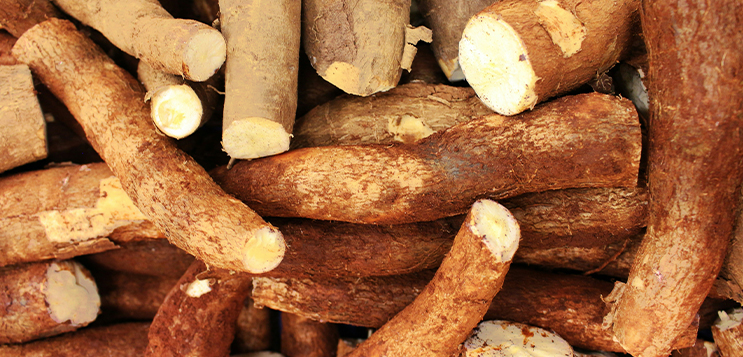
Cassava, commonly known as tapioca in India, is a starchy root crop. Its starch is already used in food, sago, textiles, paper and packaging-related industries. India’s cassava economy is concentrated, but not insignificant.
Recent ICAR-linked analysis notes that cassava is primarily cultivated in Tamil Nadu and Kerala, covering around 1.55 lakh hectares with an annual production of 5.92 million tonnes. Together, these two states account for over 87 percent of India’s cassava area and more than 93 percent of its production. In Tamil Nadu alone, more than 90 percent of the cassava harvest is processed into sago and starch.
But what if we started looking at this food crop as an alternative to the plastic menace that currently plagues the country? The Protection of Plant Varieties and Farmers’ Rights Authority notes that cassava cultivation in India is mostly found in Kerala, Tamil Nadu, Andhra Pradesh and the North-Eastern hill region, and that its use as an industrial raw material for starch production is expanding in non-traditional areas such as Maharashtra and Gujarat.
Unlike most other alternatives to plastic, cassava is already grown in India. And, unlike purely niche alternatives, it already has a processing ecosystem. So, can the ecosystem change?
What cassava starch plastic can and cannot do
Starch-based bioplastics are not new. Research on cassava starch-based biodegradable plastics has explored films, foams, packaging materials and blends. The International Society for Horticultural Science notes that starch-based plastics have advanced significantly over the past few decades, especially those derived from renewable resources. Cassava starch, in particular, has been studied for different packaging products and is considered promising in tropical and subtropical regions where cassava is a major starch source.
But cassava starch does not become plastic by simply drying a root and pressing it into a bag. Pure starch is brittle, sensitive to water and often weak in performance. To behave like a usable packaging material, it usually needs processing, plasticisers, blending with biodegradable polymers, or reinforcement with fibres and additives.
The real market is not all plastic
Cassava starch cannot replace all plastic. It is not the answer for medical devices, electronics, automotive parts, long-life containers or packaging that needs high moisture and barrier performance. The more realistic market is short-life plastic, especially where recycling is difficult or uneconomical.
That includes carry bags, garbage liners, food-service items, dry-goods packaging, agricultural mulch films, loose-fill packaging, disposable trays and some e-commerce films. These are the products that often sit at the edge of India’s waste system. They are too light to collect efficiently, too contaminated to recycle cleanly and too widely used to ignore.
For these categories, cassava starch could become part of the solution, especially if India builds a proper system around it: certified materials, domestic processing, clear labelling and composting pathways.
The biodegradability trap
In public imagination, “biodegradable” often means a product will vanish harmlessly wherever it is thrown. That is not how most alternative plastics work.
India’s rules now recognise this complexity. The Plastic Waste Management (Amendment) Rules, 2024 require compostable plastic packaging or commodities to carry the label “compostable only under industrial composting” and conform to IS/ISO 17088:2021. Biodegradable plastic must specify the number of days and the recipient environment, such as soil, landfill or water, in which it biodegrades.
That is a crucial warning. A product may be compostable in an industrial facility but behave like waste in an open dump. It may biodegrade under controlled temperature, moisture and microbial conditions but not in a clogged urban drain. It may also contaminate recycling streams if mixed with conventional plastic.
What policy must get cassava right
The 2022 EPR guidelines set targets for recycling, reuse of rigid plastic packaging and use of recycled plastic content. The government has also said that around 207 lakh tonnes of plastic packaging waste has been recycled since the EPR guidelines came into force.
But alternative materials need a parallel ecosystem. Cassava starch bioplastics will need R&D support, testing labs, CPCB certification, common standards, procurement by institutions, MSME manufacturing support and composting infrastructure. Without that, the market may fill with vague “eco-friendly” claims.
This is also where India can think industrially. Tamil Nadu and Kerala already sit at the centre of the cassava economy. If packaging innovation, starch processing and farmer supply chains are connected, cassava-based bioplastics could also develop into a rural industrial cluster. At the end of the day, yes, cassava starch can be converted into plastic, but the challenge is whether India can grab this opportunity.
