
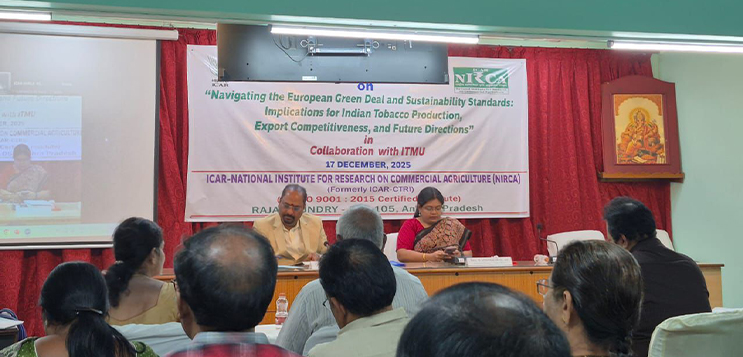
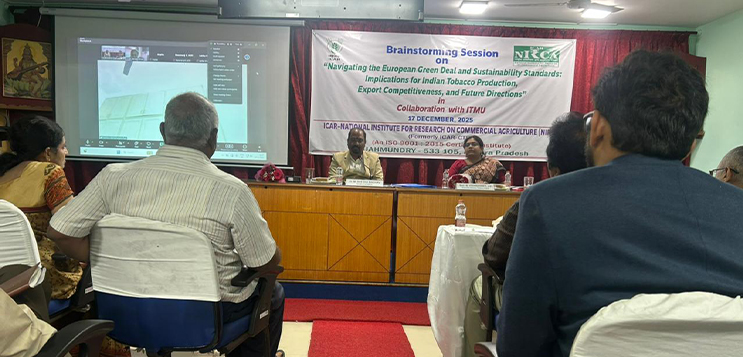
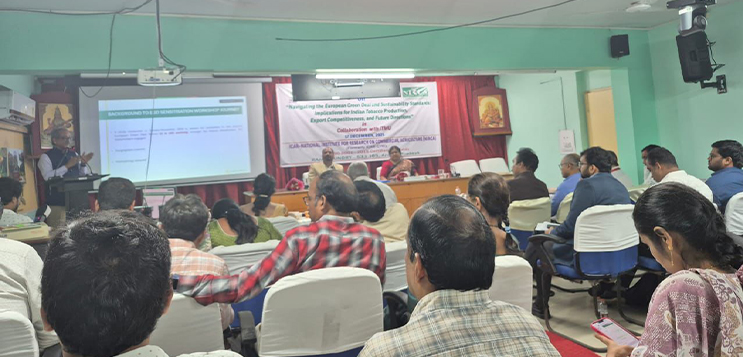
Recognising the growing implications of the European Green Deal (EGD) for Indian agricultural exports and FCV tobacco in particular, ICAR-NIRCA (Indian Council of Agricultural Research-National Institute for Research on Commercial Agriculture) organised a high-level brainstorming session on December 17th, 2025, at its Rajahmundry Head Office. The session was aptly titled “Navigating the European Green Deal and Sustainability Standards: Implication for Indian Tobacco Production, Export Competitiveness and Future Directions”
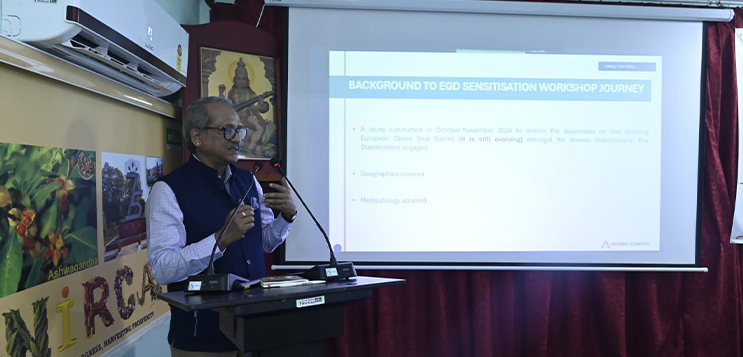
Dr. N Seshu Madhav, Director, ICAR-NIRCA and Ms. Vishwasree B, I A S, Executive Director – Tobacco Board navigated the session. Dr. Madhav set the context for the brainstorming session, and Prof. Arpita Mukherjee from ICRIER deep dived into the key aspects of EGD norms and its likely impact on the export competitiveness of FCV tobacco from India to the European Union. Mr. Kalyan Ranjan, Advisor – Sustainable Alternatives took all stakeholders present through the work done so far on organising Sensitisation Workshops for the FCV farmers across 16 auction platforms of Andhra Pradesh and the way forward. All stakeholders appreciated the lead taken by Sustainable Alternatives.
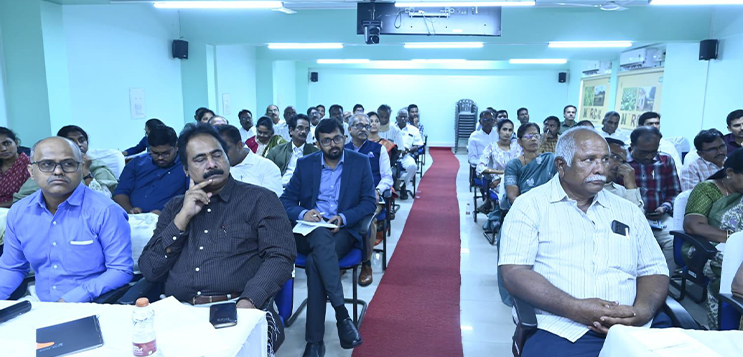
The session brought together all key stakeholders, such as policymakers, researchers, industry representatives, sustainability experts, and farmers, to assess preparedness, identify gaps, and explore pragmatic transition pathways. This dialogue aimed to move beyond regulatory abstraction and examine how EGD-linked expectations translate at the farm, processing, and export levels within India’s tobacco ecosystem.
Understanding the European Green Deal and Its Reach
Discussions underscored that the European Green Deal is not a single regulation, but a comprehensive policy framework encompassing climate, environmental, social, and economic sustainability. Its scope extends across the entire value chain, from farm-level practices and labour conditions to traceability, emissions accounting, and corporate due diligence.
Participants highlighted that upcoming European requirements are not limited to environmental metrics alone. Social safeguards, labour standards, occupational health, gender equity, and transparency in sourcing are increasingly central. Under the EU’s corporate sustainability due diligence approach, importing companies are expected to demonstrate full visibility of supply chains, identify risks, and actively mitigate them.
For Indian exporters, this shifts the compliance burden upstream. Even where Indian regulations are largely aligned on paper, the absence of structured documentation, traceability systems, and consolidated reporting could expose the sector to reputational, regulatory, and commercial risks.
Current Practices and Areas of Strength
The members of the meeting acknowledged that India’s FCV tobacco ecosystem already demonstrates several strengths. Over decades, coordinated engagement between farmers, research institutions, the Tobacco Board, and trade has embedded Good Agricultural Practices across many regions. Water-use efficiency, adoption of drip irrigation in Northern Light Soil (NLS) areas, and ongoing efforts to optimise fertiliser use were cited as examples of existing alignment with sustainability objectives.
On social parameters, stakeholders noted that child labour is largely absent in regulated tobacco cultivation, wages broadly align with state norms, and awareness of occupational safety has improved. In many cases, the practices expected under EGD are not new. However, the challenge lies in proving that these practices are consistently followed.
Key Gaps Identified
Despite this foundation, multiple gaps emerged during the discussions.
Soil Health and Input Intensity
Heavy reliance on inorganic fertilisers, declining soil organic carbon levels, and monocropping were flagged as long-term vulnerabilities. While technologies such as green manuring, integrated nutrient management, biochar utilisation, and biodegradable mulching exist, adoption remains uneven, particularly in Southern Light Soil (SLS) and Black Soil regions.
Pesticide Use and Residues
Although overall pesticide use per hectare is relatively low compared to global benchmarks, residue risks persist due to the selection of molecules, the timing of applications, and inadequate adherence to pre-harvest intervals. Participants highlighted the lack of consolidated rejection data linked to EU maximum residue limits, which limits the sector’s ability to identify high-risk practices.
Labour and Social Documentation
While most labour standards are informally met, documentation remains weak. The lack of structured records on labour engagement, wages, safety provisions, and grievance mechanisms could become a critical vulnerability under due diligence audits, even in places where the actual practices are compliant.
Curing and Emissions
Curing remains one of the most debated aspects of tobacco’s environmental footprint. While wood-based curing has traditionally dominated, alternative technologies such as LPG, electric, and solar-assisted curing have demonstrated substantial reductions in direct emissions. However, questions remain around cost, scalability, indirect emissions, and the need for policy-backed incentives to drive adoption.
Traceability and Record-Keeping
Although traceability exists from auction platforms onward, data gaps persist at the farm level, particularly regarding inputs, application intervals, and on-field practices. This “pre-auction blind spot” was repeatedly identified as a major challenge in meeting end-to-end traceability expectations.
Farmer Perspectives and Economic Realities
Across discussions and prior field engagements, farmers consistently raised one central concern: the economics of compliance. While there is openness to adopting sustainable practices, compliance is not perceived as cost-neutral. Farmers questioned whether higher input costs, additional record-keeping, and technology investments would translate into tangible price premiums or market security.
Without visible economic incentives, such as assured market access, differential pricing, subsidies, or transitional support, compliance risks are viewed as an unfunded mandate.
Towards a Structured Transition
Participants broadly agreed that the sector has time, but not complacency. Rather than reactive compliance, a phased, evidence-based transition was proposed.
Several actionable directions emerged:
- Pilot projects across distinct agro-climatic zones to demonstrate reduced fertiliser and pesticide use without yield penalties.
- Gradual phasing out of EU-banned agrochemicals through tested alternatives.
- Demonstration-scale adoption of cleaner curing technologies, supported by financial and policy mechanisms.
- Development of simple, farmer-friendly digital tools for input logging and traceability.
- Consolidation of sustainability initiatives into structured documentation and public-facing reporting frameworks.
Crucially, participants stressed the importance of coordinated action. Fragmented standards, conflicting benchmarks, or uneven expectations across buyers could undermine farmer confidence and adoption.
The discussions reaffirmed that Indian tobacco is not starting from zero. Many sustainability-aligned practices are already embedded within the system. The challenge ahead lies in closing the gap between practice and proof, aligning fragmented efforts into a coherent framework, and ensuring that farmers are not left to absorb the costs of a global transition alone.
As sustainability becomes a determinant of market access rather than a voluntary aspiration, preparedness will define competitiveness. A science-backed, economically viable, and farmer-centric approach, driven collaboratively by regulators, researchers, industry, and sustainability intermediaries, will be essential to securing the future of Indian tobacco exports in a rapidly changing global policy landscape.
Ms. Vishwasree B, I A S, Executive Director – Tobacco Board, in her concluding remarks assured that the Tobacco Board will collaborate with relevant stakeholders and extend all possible support to maintain Indian FCV tobacco’s export competitiveness.
