
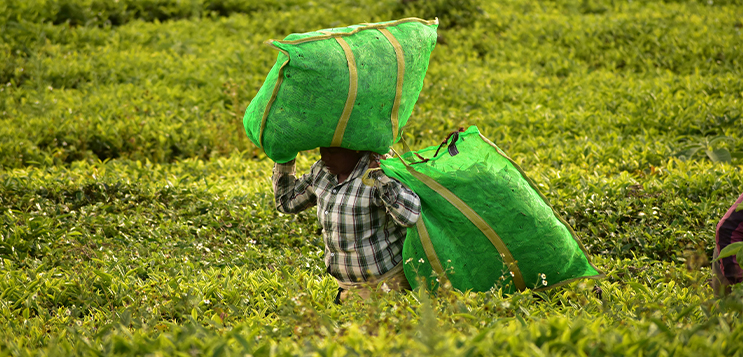
For years, the world has looked at India as a place of cheap labour, where the price differences give a huge economic advantage to global companies. It is the very same cheap labour that has also helped to keep food prices low, exports competitive and farm production more viable, despite the razor-thin margins.
However, as the European Union redraws the rules of global trade under the European Green Deal, that same labour model is quietly turning into a liability.
What began as environmental regulation has now expanded into something far broader. Today, sustainability in trade is no longer limited to carbon emissions, pesticide residues, or water use. It now includes who worked the land, how they were paid, and whether their labour can be documented. For Indian agriculture, where informality is the norm rather than the exception, this shift poses a serious risk to export access.
Labour Has Entered the Trade Rulebook
The EU’s policy direction is clear. Through instruments such as the Corporate Sustainability Due Diligence Directive (CS3D) and the proposed EU Forced Labour Regulation, which comes into effect in December 2027, European companies are being made legally responsible for human rights conditions across their supply chains, including farms and processing units outside Europe.
Under the Forced Labour Regulation, goods suspected of being produced using forced or exploitative labour can be banned outright from entering the EU market. There is no penalty, no corrective window, and no scope for negotiation once a shipment is flagged. The burden of proof shifts upstream, to exporters and producers.
Crucially, these rules do not distinguish between sectors. Agricultural imports, whether it is coffee, cotton, tobacco, spices, or rice, all of it will fall squarely within their scope.
Why Indian Agriculture Is Structurally Exposed
India’s labour structure makes it uniquely vulnerable to this shift. According to the International Labour Organization, nearly 90% of India’s workforce is informal, lacking written contracts, formal wage records, or social security coverage. Agriculture is the most informal of all. Government data from the Periodic Labour Force Survey shows that around 55% of India’s workforce is still employed in agriculture, the majority as casual or self-employed workers.
Seasonal migration deepens this informality. India has an estimated 100 million migrant workers, many of whom move temporarily across states for agricultural work, according to the Economic Survey of India. These workers are paid in cash, hired through verbal agreements, and rarely documented by landowners or contractors.
From a productivity standpoint, this system has functioned for decades. From a compliance standpoint, it is becoming indefensible. Furthermore, EU due diligence requirements increasingly expect buyers to demonstrate:
- Who harvested the crop
- Whether wages were paid and recorded
- Whether child or bonded labour was involved
- Whether basic safety and working conditions were met
This is where Indian exports face a structural gap. Land can be digitised. Inputs can be logged. Labour, in most cases, cannot.
High-Risk Crops, High-Exposure Regions
Certain crops are more exposed than others due to their labour intensity. Tobacco cultivation relies heavily on manual harvesting, curing, grading, and bundling. Cotton picking remains largely manual in many states. Tea, spices, and plantation crops depend on estate or semi-estate labour systems. Sugarcane harvesting involves migrant cutting gangs working under contractors.
These are also among India’s most export-dependent agricultural commodities. Any disruption in EU market access, especially for crops where Europe acts as a standard-setter, has ripple effects. Rejected consignments do not simply find alternative buyers overnight. They often flood domestic markets, pushing down prices and eroding farm incomes.
Child Labour in India is a Persistent Red Flag
Labour scrutiny is not limited to wages or contracts. Child labour remains a sensitive trigger in global trade. The ILO estimates that around 70 per cent of child labour globally occurs in agriculture. In India, while overall child labour has declined, agriculture continues to account for a significant share, particularly in family-run farms where children are classified as “helpers” rather than workers.
Under EU rules, intent matters less than outcome. The presence of children in production, even in family settings, can trigger red flags for European buyers who are legally obligated to demonstrate risk-free supply chains.
Why Indian Labour Violations Are Harder to Fix
Unlike pesticide residues or contamination, labour issues cannot be corrected post-harvest. A chemical violation can sometimes be retested or traced to a specific input batch. A labour violation, once alleged, affects the credibility of the entire supply chain. For EU companies, the reputational risk alone is enough to disengage. This makes labour a uniquely powerful trade barrier
The Cost of Compliance Is Falling on the Wrong Shoulders
Formalising labour comes at a cost. Maintaining worker registers, issuing wage receipts, conducting audits, and creating traceable employment systems require time and money. At present, these costs are largely being pushed onto Indian farmers and exporters, entities already operating on thin margins, while European buyers gain legal protection without sharing transition risks.
This imbalance raises a critical question: can sustainability standards survive if compliance is demanded without economic support?
The solution is not overnight formalisation or importing European labour models into Indian fields. Here are some ideas that can be implemented by private organisations and central, state or local governments to ensure proper compliance:
- Farmer Producer Organisations that pool labour documentation
- Simple worker registers
- Shared compliance platforms funded by exporters and buyers
- Gradual formalisation focused on risk mitigation
The Larger Question for Indian Exports
India’s agricultural competitiveness has long rested on affordable inputs, abundant land, and cheap labour. But as global trade enters a new phase and the EU Green Deal reshapes market access, will the Indian labour system be able to transform while there is still time? In the coming years, India may discover that cheap labour in India is pricey. And with the biggest advantage becoming a trade barrier, that cost will be borne by exporters and the farmers alike. Is the country ready for that?
