
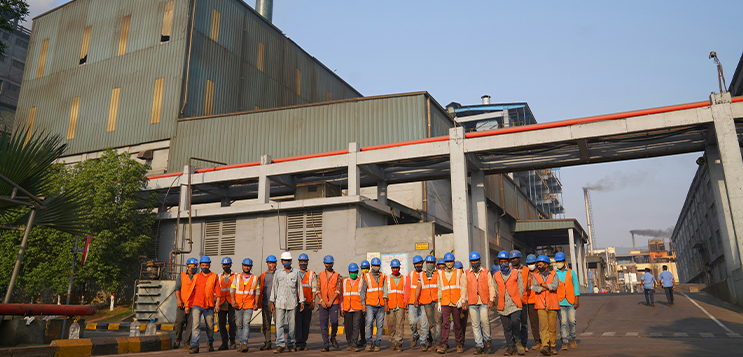
Factories in the steel towns of eastern India, such as Jamshedpur, Rourkela, and Jharsuguda, begin operations before sunrise. The conveyor belts and furnaces power up as trucks prepare to transport finished steel to global markets. For decades, these industrial clusters have played a pivotal role in India’s manufacturing growth, fuelled mainly by low-cost, coal-based energy sources.
Yet, the framework of global trade is shifting. The European Union, operating from afar, has introduced new regulations that are altering the dynamics of international exports. Unlike previous changes centred on pricing or logistics, the focus has now turned to carbon emissions. Specifically, the quantity emitted by factories, the transparency of emission disclosures, and the growing reluctance among buyers to import from high-carbon producers.
At the centre of industry unease is the European Union’s Carbon Border Adjustment Mechanism (CBAM), a policy that has triggered widespread concern across India’s steel-producing corridors. As the full impact of CBAM becomes evident, stakeholders throughout the sector are voicing alarm.
The carbon tariff that will change Indian heavy industries
The European Union’s Carbon Border Adjustment Mechanism (CBAM) is designed to hold imported goods to the same climate standards as domestically produced products. In practical terms, CBAM functions as a carbon tariff. Therefore, products with higher embedded emissions will face steeper costs when they enter the EU market.
Industry analysts say the measure signals a turning point for Indian exporters, particularly those in the steel and aluminium sectors, which rely heavily on coal-based manufacturing. Under CBAM, this dependence on coal is expected to translate directly into higher costs for Indian producers seeking access to European markets.
The European Union is set to begin levying carbon tariffs starting January 2026.
The dangerous myth of “there’s still time”
Since October 2023, European importers have been mandated to submit quarterly reports detailing the carbon emissions of imported goods. This requirement has placed immediate pressure on suppliers, including those in India, to provide precise emissions data to their European partners.
Industry surveys indicate that most Indian factories remain unable to furnish the required emissions data. Many have yet to measure plant-level emissions in the specific formats mandated by Europe, while others depend on outdated monitoring systems or lack the third-party verification stipulated by EU regulations. For small and medium-sized enterprises (SMEs), the barriers are even higher, as many lack any carbon accounting mechanisms altogether.
The consequences are already becoming apparent. European buyers unable to obtain verified emissions data from Indian suppliers face difficulties meeting CBAM reporting obligations and may opt to shift their business to competitors who can provide the necessary documentation.
Steel and aluminium: India’s most exposed heavy industry sectors
Two sectors sit squarely in the line of fire: steel and aluminium. India is a major global steel exporter, but nearly three-quarters of Indian steel is still produced through coal-dependent blast-furnace routes. Europe, meanwhile, is pushing for hydrogen-based steelmaking, scrap-based electric arc furnaces, and deep emissions reductions.
Under CBAM, every extra tonne of carbon embedded in Indian steel becomes a cost that could erase India’s price competitiveness overnight.
The story is similar for aluminium. Indian aluminium smelters are some of the most coal-intensive in the world, while European and Canadian smelters are powered mainly by hydroelectricity. CBAM penalises this difference sharply.
These two sectors sit at the core of high-value global supply chains: automobiles, construction, engineering, and packaging. A shift away from Indian suppliers will have far-reaching consequences.
The massive carbon accounting crisis in Indian heavy industries
The real problem, however, is not just high emissions. It is the inability to measure them accurately.
CBAM requires:
- Plant-level emissions data
- Verified, standardised MRV (Monitoring, Reporting, Verification)
- Digital submissions in EU formats
- Third-party auditors
- Transparent documentation
India, today, has none of these at scale. Unlike the EU, India does not have a national carbon market, a unified MRV standard, or an emissions reporting system that exporters can plug into. Most factories track energy use, but not the carbon footprint of individual product lines. Many do not have instruments calibrated to international standards. Very few SMEs have digital reporting systems.
This gap, between what Europe demands and what India can currently provide, is CBAM’s most serious threat.
Europe has already enforced CBAM on itself
European officials note that the continent is not imposing requirements on foreign producers that its own industries have not faced. For years, domestic sectors in the EU have complied with the Emissions Trading System (ETS), paying for carbon emissions and investing heavily in low-carbon technologies.
The European Union has now extended these climate regulations to imported goods. Thus, prompting several nations like South Korea, the UAE, Saudi Arabia and Turkey to begin adopting similar standards well ahead of the 2026 deadline. The developments have sparked debate within India’s policy circles over when, and how quickly, the country should accelerate its own transition.
As the January 2026 implementation date approaches, the pressure is mounting for the Indian industry and policymakers to act decisively. The months ahead will determine whether India can align with evolving global standards or risk being left behind in one of its most critical export markets.
